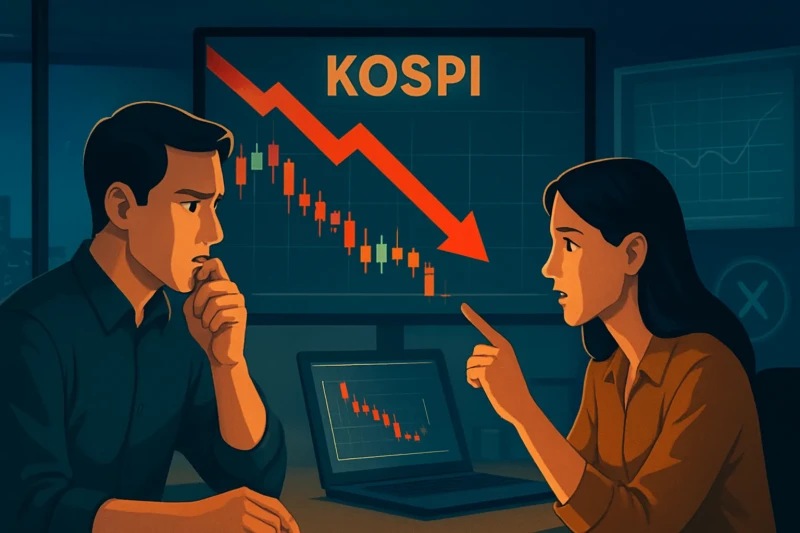
As Seoul’s morning opened, the KOSPI index posted a 9.99% drop in a single session (as of 2026-06-26T03:23:07.000Z). What looks small could spark something big.
Korea just flashed a market volatility cue—a sign global investors often miss until later.
🔍 Why Did Korea’s Market Fall So Hard?
The recent plunge in South Korea's KOSPI index is a stark reminder of how quickly market sentiment can shift. The steep decline was primarily fueled by significant sell-offs in tech giants like Samsung and SK Hynix, which lost over 7% each. This movement triggered a 20-minute trading halt and erased more than ₩366 trillion ($246 billion) from the market value. Globally, such rapid downturns are not unprecedented but the magnitude here is noteworthy, reflecting both local economic pressures and international investor sentiment.
If you’ve traded in Seoul, you know this déjà vu feeling—where sudden drops provoke strategic recalibrations.
⚡ How Does Korea Compare to Global Markets?
Korea’s recent market behavior stands out when compared to global counterparts. While Japan's Nikkei 225 also experienced a decline, it was modest at 2.8%. In contrast, South Korean markets saw retail investors stepping up with record net purchases of 11.55 trillion won, supported by elevated margin borrowing. This is quite distinct from patterns observed globally where institutional investors typically dominate recovery phases post-crash.
This raises an intriguing question: Could retail-driven recoveries indicate new growth dynamics or hidden vulnerabilities?
💡 Is There a Unique Signal from Korea?
A peculiar aspect of the Korean market is the "Kimchi Premium," which refers to the higher price of cryptocurrencies on Korean exchanges compared to global averages. Think of it like an exclusive club where access costs more locally than internationally due to demand-supply imbalances and regulatory landscapes unique to Korea.
This anomaly often acts as an early warning system for potential shifts in crypto liquidity and investor sentiment across Asia.
🎯 What Should Investors Consider Next?
Navigating these turbulent waters requires both caution and strategic agility. Conservative investors might focus on diversification or hedging strategies to mitigate risks tied to such volatile environments. Meanwhile, active traders could look for short-term opportunities arising from temporary mispricings or arbitrage possibilities linked to instruments impacted by exchange rate fluctuations or regional policy updates.
🚀 What's Your Next Move?
Add KRW turnover share to your watchlist—tomorrow’s move could be the surprise setup.
If you’re looking ahead, consider whether these events signal broader trends affecting Asian markets or isolated incidents specific to Korea’s unique financial ecosystem.
What do you think this means for the market?

