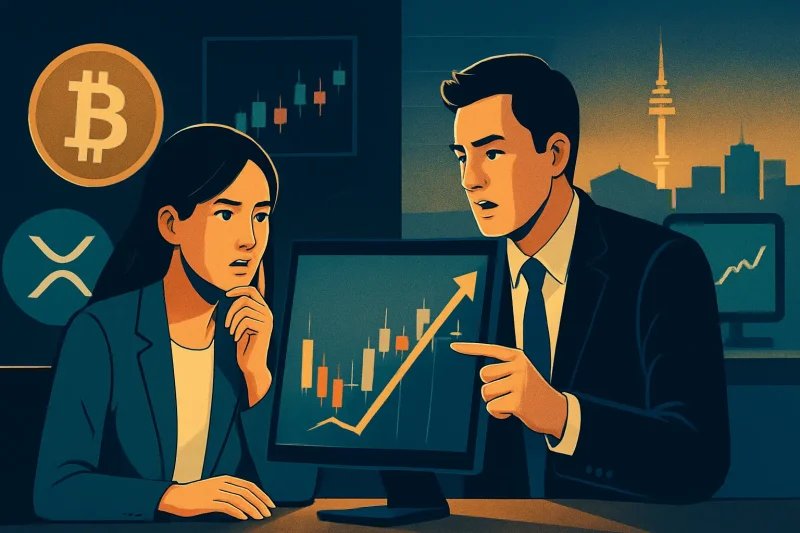
As Seoul’s morning opened, Bitcoin posted a 2.5% increase (as of 2026-07-11T15:01:39.000Z). What looks small could spark something big.
Korea just flashed a subtle market signal—a sign global investors often miss until later.
🔍 Why Does Korea's Crypto Market Matter?
The South Korean crypto market plays a pivotal role in the global landscape due to its high trading volumes and unique investor behaviors. With significant activity concentrated on platforms like Upbit and Bithumb, South Korea consistently ranks among the top countries for cryptocurrency transactions. This makes it an invaluable barometer for potential global shifts, especially when we consider that local sentiments often precede broader market trends by days or even weeks.
If you’ve traded in Seoul, you know this déjà vu feeling when seeing similar patterns echo globally soon after.
⚡ How Do Korea's Trading Patterns Compare Globally?
A recent analysis shows that while global Bitcoin trading volume hovered around $30 billion, Korean exchanges alone contributed approximately $5 billion, representing about 16.7% of the total (as of 2026-07-11T15:01:39.000Z). This outsized influence is apparent when examining price fluctuations; during high volatility periods, prices on Korean exchanges often diverge by 3%-5% compared to Western counterparts.
This discrepancy can offer arbitrage opportunities for astute traders who are quick enough to react. Do you see this as an opportunity worth exploring?
💡 What Unique Signals Emerge from Korea?
The "Kimchi Premium" is a distinct phenomenon where cryptocurrencies trade at higher prices in South Korea than elsewhere. Often driven by regulatory news or shifts in local investor sentiment, this premium reflects both demand intensity and the localized perception of risk and opportunity.
An analogy might be the difference between stock prices on different exchanges like the NYSE versus smaller regional markets—where local factors can heavily influence valuation regardless of broader trends.
🎯 What Should Be on Your Next Trade Watchlist?
Your investment strategy should consider both immediate signals like trading volume spikes and longer-term cues such as regulatory developments out of Seoul. For conservative investors, monitoring stablecoin movements might help gauge underlying capital flows without taking on unnecessary risks.
If you're more active in your trades, keeping tabs on order book depths across major Korean platforms could reveal hidden liquidity pockets ripe for exploitation. Is this part of your current checklist?
🚀 What's Next for Global Investors?
Add KRW turnover share to your watchlist—tomorrow’s move could be the surprise setup that aligns with ongoing macroeconomic narratives or unexpected geopolitical developments affecting currency pairs globally.
What do you think this means for the market?

