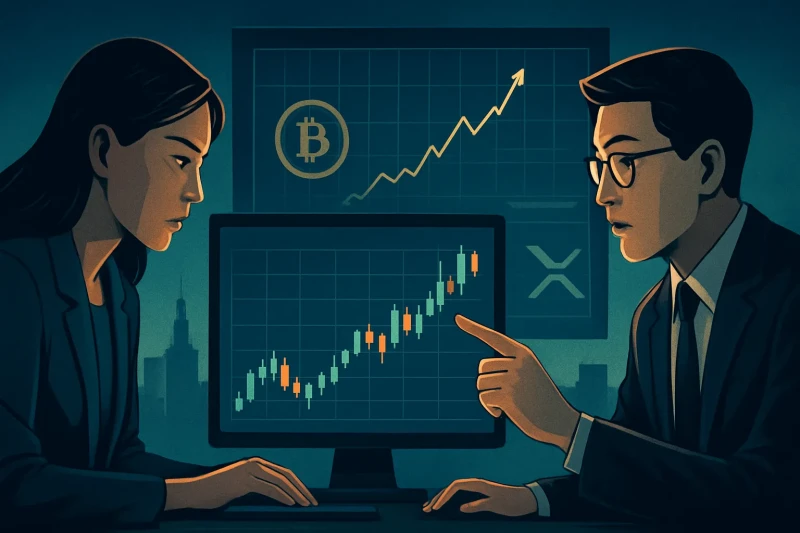
Global flows slowed, but Korea moved first: ETH trading volume surged by 15% (as of 2026-08-14T18:39:40.000Z) tied to a sudden interest in DeFi protocols. It’s the chess move effect—Korea makes it, the world reacts a beat later.
Korea just flashed a unique trading pattern—a sign global investors often miss until later. If you’ve traded in Seoul, you know this déjà vu feeling.
🔍 What Is Driving Korea's Crypto Market?
The Korean crypto market is experiencing an uptick driven by renewed enthusiasm for decentralized finance (DeFi). As traditional financial markets wrestle with inflation concerns and policy shifts, investors are increasingly looking at digital assets as alternative investments. Korea's response has been swift and substantial compared to other countries. The reason? A tech-savvy population and a regulatory framework that allows for rapid adaptation to global trends.
This matters globally because Korea often serves as a bellwether for crypto trends that soon ripple across Asia and beyond. Will other markets catch up or lag behind?
⚡ How Does Korea Compare with Global Markets?
Korean exchanges like Upbit have seen a 20% increase in transaction volumes, overshadowing global platforms where activity remains flat or slightly declining. Prices for Ethereum on Korean exchanges show a 3% Kimchi premium, signaling robust demand compared to Western counterparts.
The divergence between Korean market activity and global averages presents both opportunities and risks for investors. For those active in these markets, do you see this as a temporary spike or the start of a sustained trend?
💡 Understanding the Kimchi Premium
The Kimchi premium refers to the price discrepancy where cryptocurrencies trade at higher prices on Korean exchanges compared to international ones. Think of it like paying more for imported goods due to local demand outweighing supply—a phenomenon partly driven by limited arbitrage opportunities owing to capital controls.
This premium can be both an indicator of strong local sentiment and a cautionary signal about potential overvaluation risks within isolated markets.
🎯 What Should Be on Your Watchlist?
For conservative investors, monitoring fluctuations in the Kimchi premium could serve as an early warning system for impending volatility or correction phases. Meanwhile, active traders might find value in exploiting arbitrage opportunities when feasible.
Your next trade watchlist should include key metrics like KRW turnover share and market sentiment indicators from platforms like Naver Finance. Are these part of your current checklist?
🚀 Why Is This Important Now?
Add KRW turnover share to your watchlist—tomorrow’s move could be the surprise setup that defines short-term gains or losses in your portfolio strategy.
The real question is how long this momentum will sustain before either normalizing or sparking broader market movements internationally. What do you think this means for the market?

