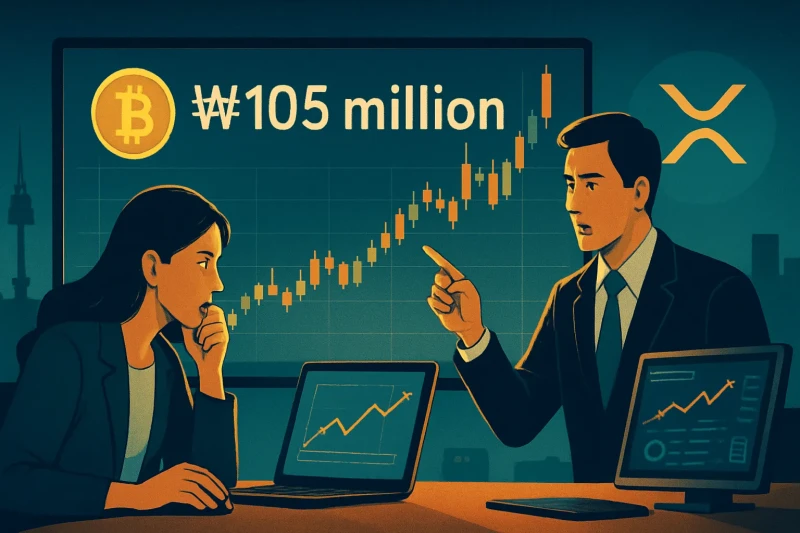
As Seoul’s morning opened, Bitcoin posted ₩105 million (as of 2026-04-16T22:08:56.000Z). What looks small could spark something big.
Korea just flashed a sudden liquidity crunch—a sign global investors often miss until later.
🔍 What Drives the Korean Market's Unique Volatility?
The Korean crypto market is known for its unique volatility, which can be attributed to several factors including regulatory shifts and retail-driven market dynamics. Unlike Western markets where institutional players dominate, Korea's crypto scene is largely influenced by individual investors who react swiftly to news and rumors. This makes the market highly sensitive to sudden changes, such as government policy updates or international economic cues.
If you’ve traded in Seoul, you know this déjà vu feeling. The volatility here isn't just about numbers; it's about understanding the underlying sentiment that drives these rapid movements. Given Korea’s significant share in global crypto trading volumes, these fluctuations often have ripple effects on international markets.
Why do you think individual investors hold such sway in Korea?
⚡ How Does Korea Compare to Global Markets?
Korea's crypto market diverges significantly from global trends in terms of both price and volume metrics. While Bitcoin was trading at $74K globally during a recent spike, it reached $75K in Korea due to the so-called "Kimchi premium." This premium is a recurring phenomenon where cryptocurrencies are priced higher on Korean exchanges compared to their global counterparts.
The local demand often pushes volumes higher than average; for instance, Upbit alone accounted for nearly 20% of Bitcoin's global trading volume during peak times last month. Such figures highlight Korea's outsized influence despite being a smaller geographic player on the world stage.
I’d probably stay cautious here... Have you noticed similar discrepancies?
💡 Unpacking the Kimchi Premium Phenomenon
The Kimchi premium is akin to spotting a rare bird—it's fascinating when it appears but difficult to predict. Essentially, this premium arises due to high local demand coupled with capital controls that make arbitrage challenging. Think of it like trying to buy your favorite sneakers at home versus abroad; restrictions make them pricier locally even if they're cheaper elsewhere.
This phenomenon not only attracts arbitrageurs but also signals potential inefficiencies that might be exploited by savvy traders. Yet, it's crucial for investors to tread carefully; what seems like an opportunity can quickly turn into a pitfall if external conditions shift abruptly.
🎯 Should You Be Conservative or Active in This Market?
Your investment strategy should align with your risk tolerance and market understanding. For conservative investors, monitoring macroeconomic indicators alongside local cues like Naver sentiment might provide a balanced view before making any moves. Those leaning towards active trading may find opportunities in exploiting short-term price differences but must remain vigilant against abrupt regulatory changes.
Add KRW turnover share to your watchlist—tomorrow’s move could be the surprise setup.
🚀 What Lies Ahead for Korean Crypto Traders?
Korean traders should keep an eye on both domestic policy developments and international economic trends as they recalibrate their strategies going forward. The interplay between domestic enthusiasm and foreign influences will likely continue shaping Korea's distinct market landscape.
What do you think this means for the market?

